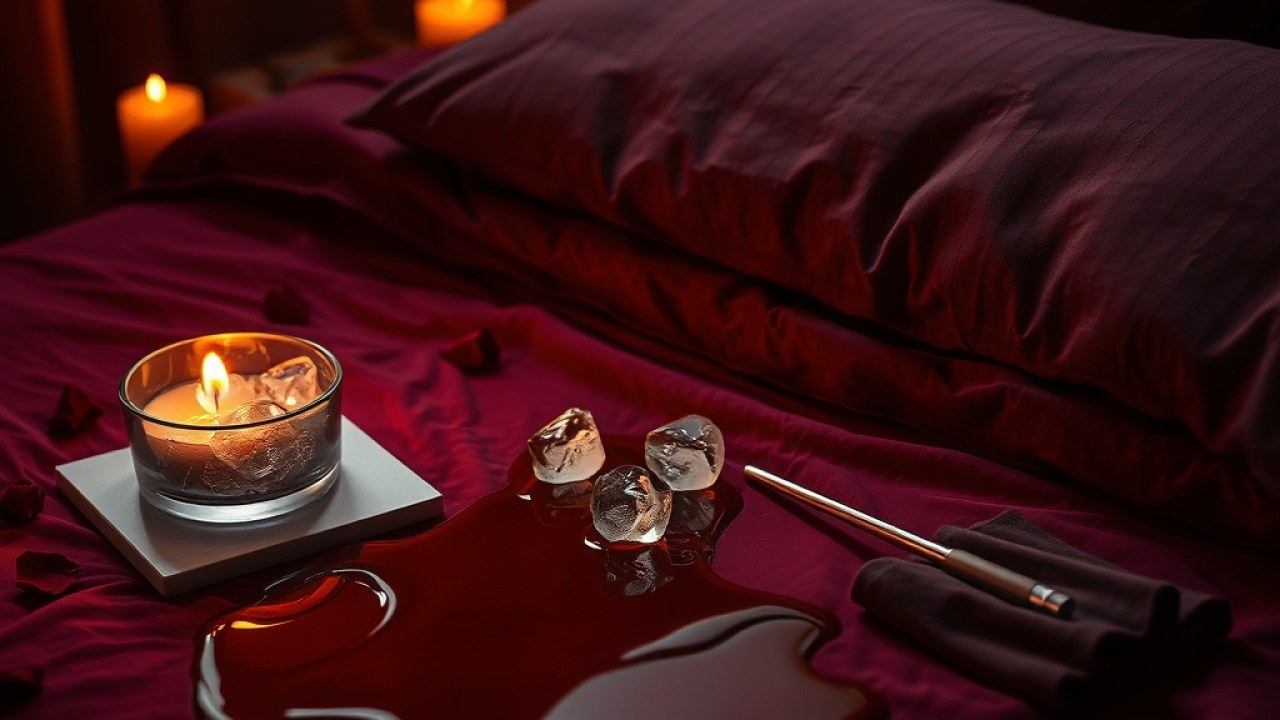
The wax doesn't fall. It lands — a molten kiss that spreads across the curve of a shoulder blade, the swell of a breast, the trembling plane of a lower belly. For a heartbeat, there's only the shock of it: heat so sudden it reads as cold, the nervous system caught in a lie. Then the wax cools, shrinks, tightens. The skin beneath flushes. A breath drags in. Another drop follows. Then another. This is wax play at its purest: a negotiation between surrender and control, written in temperature and time.
Temperature play is the original low-tech, high-yield kink. No apps, no subscriptions, no firmware updates. Just fire, ice, and the courage to stay present while someone you trust traces the edge of your tolerance. On live interactive webcams, you'll see it negotiated in real time — a creator testing a candle's heat on their own wrist before asking a viewer, "Ready for the next one?" The chat holds its collective breath. That's the show. But the craft? The craft lives in the preparation nobody sees.
"Wax play isn't about pain. It's about precision. The drop that makes someone arch isn't the hottest one — it's the one placed exactly where the skin is thinnest, the anticipation highest, the trust deepest."
Know Your Wax: The Chemistry of a Safe Burn
Not all candles belong on skin. The paraffin pillars from the grocery store burn at 130–150°F (54–66°C) — hot enough to cause second-degree burns in seconds. Body-safe massage candles are formulated with soy, coconut, or beeswax bases blended with shea butter, jojoba, and vitamin E. They melt at 100–115°F (38–46°C), a range that delivers intense sensation without tissue damage.
Read the label. If it doesn't explicitly say "massage candle" or "body-safe," it doesn't go near a scene. Brands like Lovehoney, Je Joue, and Bellesa publish melt-point data. Test every new candle on your own inner wrist first. Hold the flame there for three seconds. If you flinch, it's too hot for a partner's inner thigh.
The Ice Counterpoint
Ice isn't just frozen water — it's a tool with texture, melt rate, and thermal conductivity. Cubes from a standard tray melt fast and slick. Spheres from a silicone mold last longer, roll better, and deliver a more deliberate glide. For extended play, freeze water in a condom or latex glove (tied off) to create a handled wand that won't slip. Some creators on creator video archives swear by stainless steel wands chilled in ice water — they hold cold without the melt mess and allow surgical precision.
Anatomy of a Drop Zone: Where to Drip, Where to Never Drip
The body is not a uniform canvas. Skin thickness, nerve density, vascular proximity, and hair growth all change the calculus. Here's the map.
Green Zones — High Reward, Low Risk
- Upper back and shoulders: Thick skin, few surface vessels, huge sensory payoff. The trapezius ridge takes heat beautifully.
- Outer thighs and glutes: Ample subcutaneous fat buffers the heat. The gluteal fold is a sweet spot — sensitive, private, and safe.
- Lower back and sacrum: Broad, flat, responsive. The dimples of Venus (the posterior superior iliac spines) are architectural perfection for pooling wax.
- Chest and outer breast tissue: Avoid the areola and nipple initially. The pectoral slope and lateral breast take wax like champagne.
Yellow Zones — Proceed With Communication and Caution
- Inner thighs: Thin skin, major femoral vessels nearby. Use cooler wax, higher pour height, smaller drops.
- Abdomen and hips: Variable fat padding. The iliac crest is bony — wax pools and concentrates heat there.
- Arms and forearms: Hair can trap wax painfully. Shave or trim first, or use oil barrier.
Red Zones — Hard No for Wax
- Face, neck, and throat: Airway risk, eye damage, carotid proximity. Never.
- Genitals (direct contact): Mucosal tissue burns at lower temperatures. The frenulum, clitoral hood, glans, and vaginal/introital tissue are not wax territory.
- Nipples and areolae: Thin skin, dense nerve endings, erectile tissue. Use ice or cooled metal here instead.
- Feet soles and palms: Thick callus masks heat until damage is done.
- Any broken skin, fresh tattoos, moles, or varicose veins: Obvious, but violated more often than you'd think.
"The most dangerous drop is the one you place without asking. Consent isn't a checkbox — it's a running commentary. 'Here?' 'Hotter?' 'Stay?' That dialogue is the scene."
Technique: The Choreography of Contrast
Great temperature play is composed, not improvised. The sequence matters as much as the placement.
Phase 1: The Warm-Up (10–15 Minutes)
- Set the room. 72–75°F (22–24°C). No drafts. Dim, warm light — candlelight itself is ideal.
- Lay protection. A Liberator Fascinator Throe or heavy towel. Wax ruins sheets and stains foam.
- Oil barrier. Light coating of coconut or jojoba oil on target zones. It prevents wax from grabbing hair, eases removal, and adds glide for ice.
- Light the candle 10 minutes before play. You need a full melt pool, not a tunneling wick. Stir gently with a clean spoon to even the temperature.
- Test on yourself. Every. Single. Time.
Phase 2: The First Heat (5–10 Minutes)
Start high — 18–24 inches above skin. The wax cools in flight. Land three drops on a green zone. Watch. Listen. Ask. Then lower the pour height by two inches per round. Each drop arrives hotter. Build a constellation — clusters of three, negative space between. Let each drop cool fully before the next lands nearby. The skin's memory of the previous drop amplifies the next.
Phase 3: The Ice Intervention
When the wax has cooled to body temperature (about 90 seconds), introduce ice. Don't just rub — trace. Drag a cube along the wax's edge. Circle a hardened pool. Press a melting sphere into the hollow of a clavicle. The contrast triggers a vascular flush: heat draws blood up, cold drives it deep, the oscillation lights every thermoreceptor. Alternate 30 seconds of ice with 60 seconds of stillness. Let the body recalibrate.
Phase 4: Layering — The Advanced Move
Re-warm the candle. Drip fresh wax onto cooled wax. The new drop melts the old, fusing layers, creating depth and prolonged heat release. This is where the shiver becomes a tremor. Only attempt on green zones with established communication. Maximum two layers before removal.
Phase 5: The Peel
Removal is its own sensation. Use fingertips — not nails — to lift an edge. Peel slowly, like a bandage you want to feel. The skin underneath is flushed, hypersensitive, alive. Now is the moment for a feather, a fingernail drag, a tongue. The contrast window is wide open.
Tools of the Trade: What Lives in the Kit
- Two massage candles (different scents/melt points for variety)
- Silicone ice molds (spheres, spears, wands)
- Stainless steel wand (Njoy Pure Wand or similar — chill in ice water, not freezer)
- Coconut oil (organic, unrefined — barrier and cleanup)
- Soft microfiber cloths (for wiping melt, drying skin)
- Blunt-tipped scissors (for hair emergencies)
- Bowl of cool water + washcloth (immediate cool-down if needed)
- Aftercare kit: arnica gel, aloe vera, water bottles, chocolate, weighted blanket
Communication Protocol: The Vocabulary of Sensation
Safe words work, but temperature play benefits from a richer dialect. Adopt a three-tier system:
- "Green" — harder, hotter, closer, more.
- "Yellow" — pause, don't stop. Hold this temperature. Let me catch up.
- "Red" — immediate cessation. Remove wax. Ice water. Check-in.
- "Blue" (optional) — emotional overwhelm. Not physical intensity. Need holding, not cooling.
Check in every 90 seconds during active play. "Color?" One syllable. Eye contact. A nod continues. A shake pauses. This rhythm becomes its own foreplay.
Hygiene & Risk Mitigation: The Boring Part That Keeps You Playing
- Never share candles between partners without a pour-off protocol. Decant into a clean metal pitcher for each person.
- No double-dipping ice. Melted cube = discarded. Fresh cube = new sensation.
- Trim the wick to ¼ inch before every session. Long wicks = soot = irritants on sensitized skin.
- Fire safety: Candle on a ceramic tile or metal tray. Never on fabric. Lighter within reach, not in hand during play. Extinguisher in room.
- Allergy check: Soy, coconut, shea, essential oils. Patch test 24 hours prior if new brand.
- Medical flags: Diabetes (impaired sensation), neuropathy, Raynaud's, blood thinners, recent sunburn, Accutane use — all contraindicate or require medical clearance.
Aftercare: The Ritual That Makes It a Memory Worth Repeating
The scene ends when the aftercare ends. Not before.
- Immediate (0–5 min): Remove all wax. Cool compresses on any red zones. Water. Skin-to-skin contact. Blanket.
- Short-term (5–30 min): Arnica on any tender areas. Aloe on flushed skin. Protein + sugar snack. Pee (prevents UTI from urethral irritation).
- Debrief (30–60 min): "What was the hottest moment?" "Where did you edge toward yellow?" "What do we adjust next time?" Notes go in a shared note app or paper journal.
- Follow-up (24 hrs): Text check-in. Photo of any marks (with consent) for tracking healing. This data builds the next scene.
Creators who skip aftercare don't get repeat viewers. The ones who treat it as the final act — the slow stroke, the water glass offered without asking, the "I've got you" whispered into damp hair — those are the ones whose live interactive webcams have waitlists.
When It Goes Wrong: Emergency Protocols
Wax stuck in hair: Don't pull. Saturate with oil. Wait five minutes. Comb out with wide-tooth comb.
Burn (red, blistering, >3" diameter): Cool running water 10–20 minutes. No ice direct. Sterile non-stick dressing. Urgent care if on face, hands, genitals, joints, or >3 inches.
Fainting/vasovagal response: Lower head below heart. Loosen clothing. Cool cloth to neck. Monitor breathing. Call 911 if unconscious >30 seconds.
Fire: Smother with fire blanket or lid. Never water on wax fire. Extinguisher if spreading.
The Fantasy Lives in the Discipline
Anyone can light a candle. The art is in the restraint — the drops you don't make, the seconds you wait, the questions you ask instead of assuming. Temperature play rewards the patient. The shiver you're chasing isn't in the wax. It's in the trust that lets someone stay still while fire kisses their skin, knowing ice will follow, knowing hands will catch them, knowing the aftercare is already packed.
That's the show worth watching. That's the scene worth living.
Ready to see how the pros orchestrate the burn? Drop into a live interactive webcams session tagged "wax play" or "temperature tease" — or study the archives where creators break down their kits, their protocols, and the drops that made someone beg.